
How do you save on postage?
By making the choices before anything is printed. Size and weight decide which rate band you fall into, and one millimetre or one gram over the line changes the postage on the whole run.
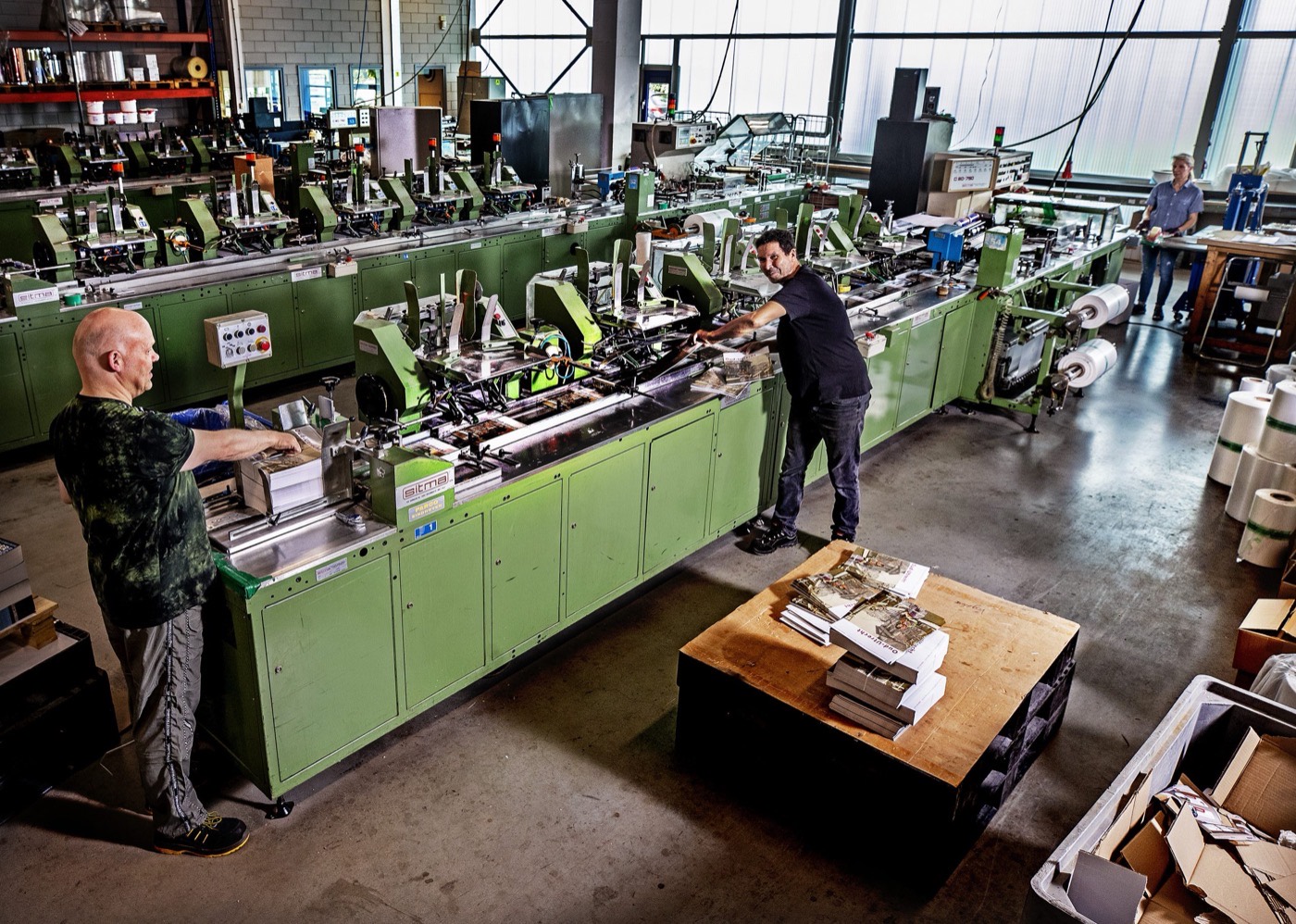
Last updated: 21 August 2026 · Mark Bonenkamp, managing director of Vogelaar, chair of Stichting Postfilter and of the Postal Committee of the KVGO and member of the Postal Committee of the DDMA
1 · Fix size and weight before the design
This is the most expensive mistake we see in practice, and the easiest to avoid. A mailing that falls just outside letterbox size, or just into a heavier weight band, costs more across the whole run. At ten thousand items that adds up, and by then the design is already there.
PostNL charges bulk mail in six weight bands, and a letterbox item has to stay within one size.
| Maximum letterbox size | 380 × 265 × 32 mm |
| Bulk mail weight bands | 0–20 g · 20–50 g · 50–100 g · 100–350 g · 350–1,000 g · 1,000–2,000 g |
| Bulk mail products | Klein · Groot · Speciaal · Gemengd · Gemengd extra |
Source: PostNL, rate booklet "Tarieven en diensten", effective 12 July 2026.
In practice this means: choose the band you want to fall into first, and design towards it. Paper type, weight, the number of sections and the insert together decide the weight. We cost that up front, and where it gets tight we say which choice keeps the band open. A lighter paper or one section fewer is often cheaper than the next weight band.
2 · Mail unwrapped where you can
Film costs money, costs an operation and costs weight. Where the contents allow it, we address straight onto the cover or onto the envelope and the mailing goes out without film. That saves material and an operation in production.
Addressing on film is not possible: the address has to be on the carrier itself. If you do want film, for instance because there are loose components in the item, then the cover is the address carrier.
3 · Mail only what will arrive
Every item that does not arrive is money thrown away twice: the postage and the print. An address file that is a year old contains recipients who have moved, duplicate records and people who have died.
Addressed mail is allowed, provided you consult Postfilter and the deceased register before dispatch. We have access to both registers and will de-duplicate and clean your file if you instruct us to. What that means for what you may and may not send is on our page about Postfilter and the YES sticker.
4 · Choose the dispatch moment deliberately
Not every mailing has to be on the mat on a fixed day. If you are not tied to a date, you can choose a delivery option that suits the pace of your campaign, and that makes a difference to the rate.
In its rate booklet PostNL distinguishes three options: Standaard, delivery on the next two delivery days; Vast, two pairs of two consecutive delivery days; and Next week Flex, listed in the rate booklet as Flex, where the item is delivered the following week on flexible delivery days. That last one applies only to the Groot and Speciaal products.
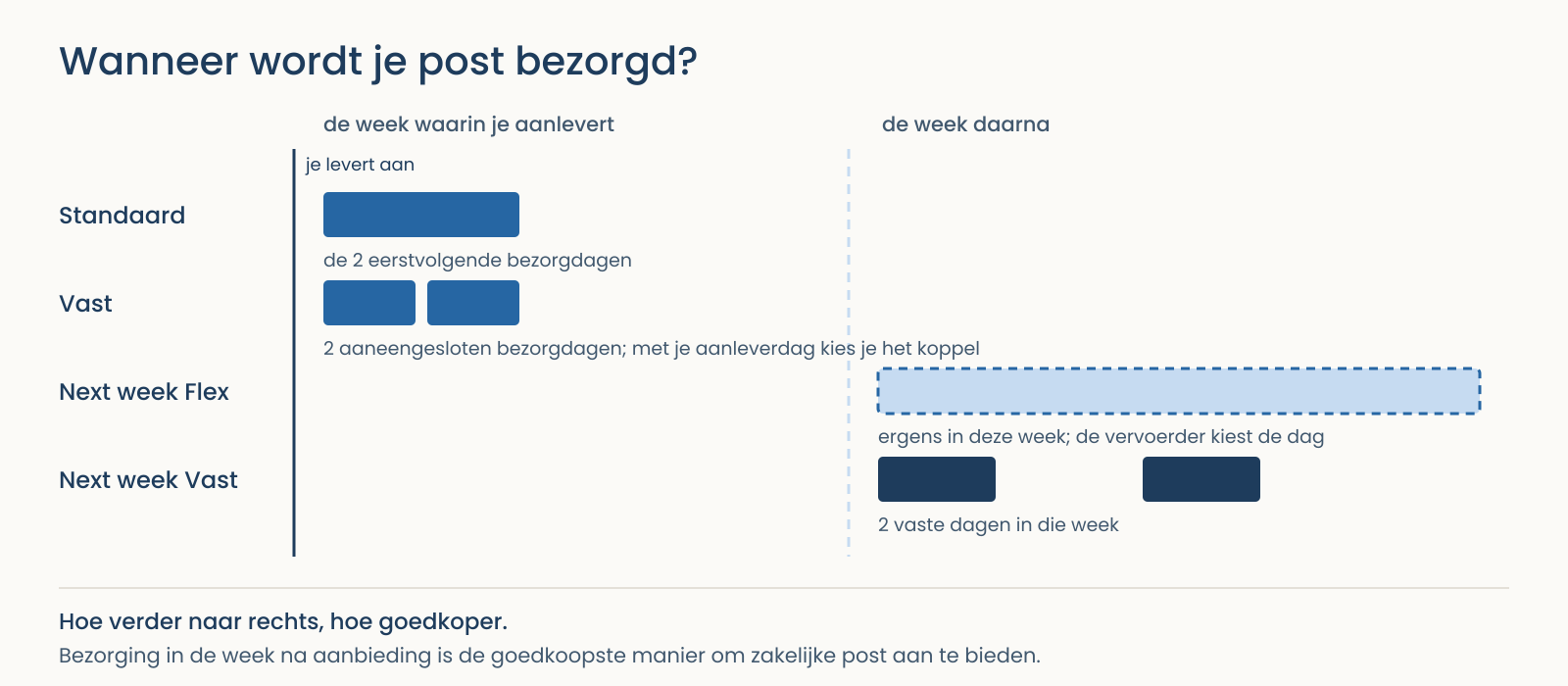
We do not promise a delivery day on the carrier's behalf. What we do set down is our own planning: when your file has to be in, when we print, and when we hand in.
5 · Hand in the way the carrier wants it
This is where the least well-known discount sits. Anyone who codes, sorts and splits their mail the way PostNL wants it pays less. That is exactly the work we do, and it is why the addresses and the layout have to be brought together here: without coding and sorting the discount lapses.
| Discount | What it applies to |
|---|---|
| Volume discount | From 25,000 letterbox items a year, at least 3% |
| Coding discount | Depends on the size |
| Sorting discount | For Groot and Speciaal batches from 5,000 items |
| Splitting discount | For domestic Gemengd and Gemengd extra batches from 2,500 items: 1.0 eurocent per item |
Source: PostNL, rate booklet "Tarieven en diensten", effective 12 July 2026. Rates and conditions change; see postnl.nl for the current version.
Joining our volume helps with that. Our production can handle more than half a million mail items a day, and millions go through it a year. We hand in according to the carrier's delivery conditions, so a run that is too small for a rate band on its own still falls into the right sorting with us.
The five levers at a glance
| Lever | When you set it | What it affects |
|---|---|---|
| Size and weight | Before the design | The rate band of the whole run |
| Wrapping | At finishing | Material and an operation |
| Address file | Before printing | Postage and print on every item that does not arrive |
| Dispatch moment | At planning | The delivery option and therefore the rate |
| Handing in | In production | Coding, sorting and splitting discounts |
The first lever is the biggest, and it is also the one that closes first. So call us before the design rather than after.
Want to know what your mailing costs? Direct mail sets out what we do and how it runs. If you already know what you want to send, request a quote and we will cost it out, including the rate band you fall into.
More in Insights
This article belongs to Direct mail. Back to the overview, or carry on with one of these.