
Which paper size do you choose, and what does it weigh?
The A series runs from A0 to A10, with each next size half the previous one. Together with the paper type, the size determines the weight, and the weight determines the postage. So choose the size first, and only then the design.
Last updated: 22 August 2026 · Dave Counotte, print production manager at Vogelaar
How the A series works
The A series is set out in ISO 216, in force since 1975 and the successor to the German DIN 476 of 1922. Two things are fixed in it, and the rest follows.
A0 has an area of exactly one square metre. And every size has the same ratio between its sides, 1 to √2. Because of that, folding a sheet across the middle always gives you the same shape again, one size smaller. Fold an A3 in half and you have A4.
The number in the name says how many times A0 has been halved. So A4 has been halved four times: one sixteenth of a square metre.
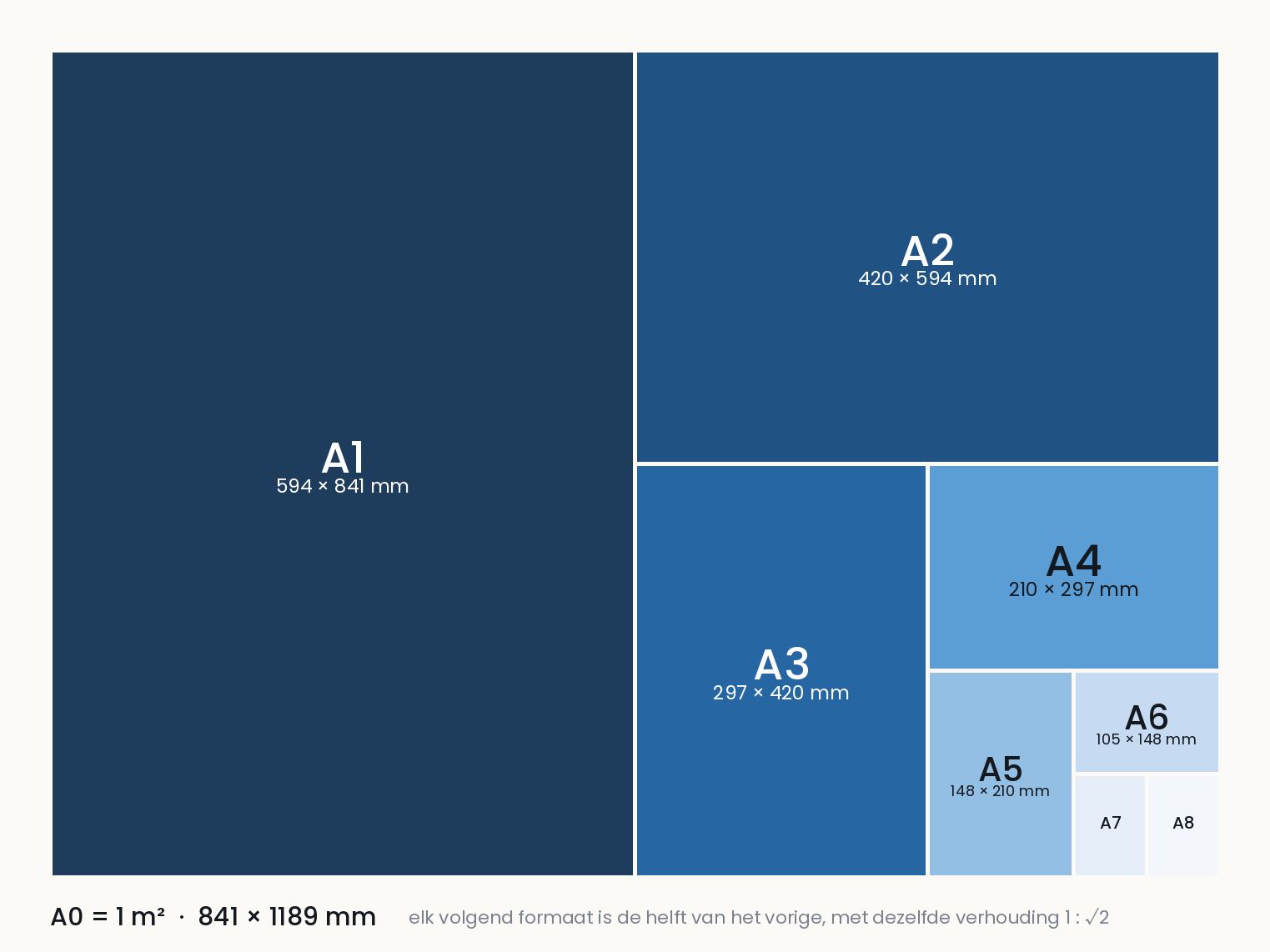
| Size | Portrait (mm) | Where you meet it |
|---|---|---|
| A0 | 841 × 1189 | Posters, billboards |
| A1 | 594 × 841 | Pavement signs, large posters |
| A2 | 420 × 594 | Posters, calendars |
| A3 | 297 × 420 | Bills, calendars |
| A4 | 210 × 297 | Letterhead, brochures, magazines |
| A5 | 148 × 210 | Flyers, invitations, manuals |
| A6 | 105 × 148 | Cards, leaflets |
| A7 | 74 × 105 | Tickets, vouchers |
| A8 | 52 × 74 | Business cards, stickers |
If the format lies on its side, that is called oblong. Nothing else changes: the same size, a different orientation.
What a paper weight actually tells you
Paper is described in grams, for example 80 gsm. That figure is the weight of one square metre of that paper, and therefore the weight of one sheet of A0.
You can derive everything from that. An A4 is one sixteenth of a square metre, so a sheet of 80 gsm A4 weighs 80 divided by 16, which is 5 grams. It works the same way for every size:
| 80 gsm | 120 gsm | 170 gsm | 250 gsm | |
|---|---|---|---|---|
| A4 | 5.0 g | 7.5 g | 10.6 g | 15.6 g |
| A5 | 2.5 g | 3.8 g | 5.3 g | 7.8 g |
| A6 | 1.3 g | 1.9 g | 2.7 g | 3.9 g |
A higher figure means firmer, thicker paper. For a card that has to go through the letterbox you want firmness; for a mailing with several sheets you want to save weight. On top of that there is the difference between coated and uncoated paper: coated is smooth and gives sharper colours, uncoated feels rougher and is nicer to write on.
From size to postage, and why that comes first
This is where the two meet. PostNL charges bulk mail in weight bands, and the first runs up to 20 grams. Your item is the sum of everything in it: the print, the envelope, the insert.
Work the example through. An invitation on A5 in 250 gsm weighs 7.8 grams. Fold an A4 of 120 gsm down to A5 instead and you are at 7.5 grams, and then you have four pages instead of two. Almost the same weight, twice the space.
That is the kind of choice that has to be made before the design and not after. One gram over the line changes the postage on the whole run, and at ten thousand items that adds up. Exactly how those bands run and where the discounts sit is on saving on postage.
We cost the whole item up front and say where it gets tight.
Which sizes we can handle ourselves
This question is rarely asked and does make the difference: a size your supplier cannot make in one pass becomes more expensive and slower.
Our whole line is set up for SRA3+, in our case up to 340 × 550 mm. For comparison: SRA3 is 320 × 450 mm, a sheet just larger than A3 so that bleed and crop marks fit on it. SRA3+ is a step larger again.
Everything up to and including that size we print, fold and wrap ourselves, in house, in one continuous line. That covers A6, A5, A4 and A3, and therefore almost every card, flyer, brochure and mailing. No intermediate stop at a third party, no transport in between, and one company responsible if something is not right.
Above that size it becomes a different story. For large-format posters we have a wide-format printer, up to and including A0, and that is intended for small quantities. Large runs at large format we do not do ourselves.
The B series and the C series
Besides the A series there are two more, with the same ratio but a different starting point.
The B series sits in between each time: B5 is larger than A5 and smaller than A4. Useful when an A size is just too small and the next one just too large.
The C series is for envelopes. They are made so that the matching A size fits exactly: an A4 goes into a C4, and folded down to A5 into a C5.
Unsure about size, paper or weight? Send us what you have in mind and we will cost it out and say what the difference is. See what we make at print, or request a quote.
More in Insights
This article belongs to Print. Back to the overview, or carry on with one of these.