
When do you outsource fulfilment, and when not?
Outsourcing pays off as soon as storage, packing and shipping cost you time and space on a structural basis that you would rather spend on selling. Keep it in house while your volume is small, or while the packing is part of your product.
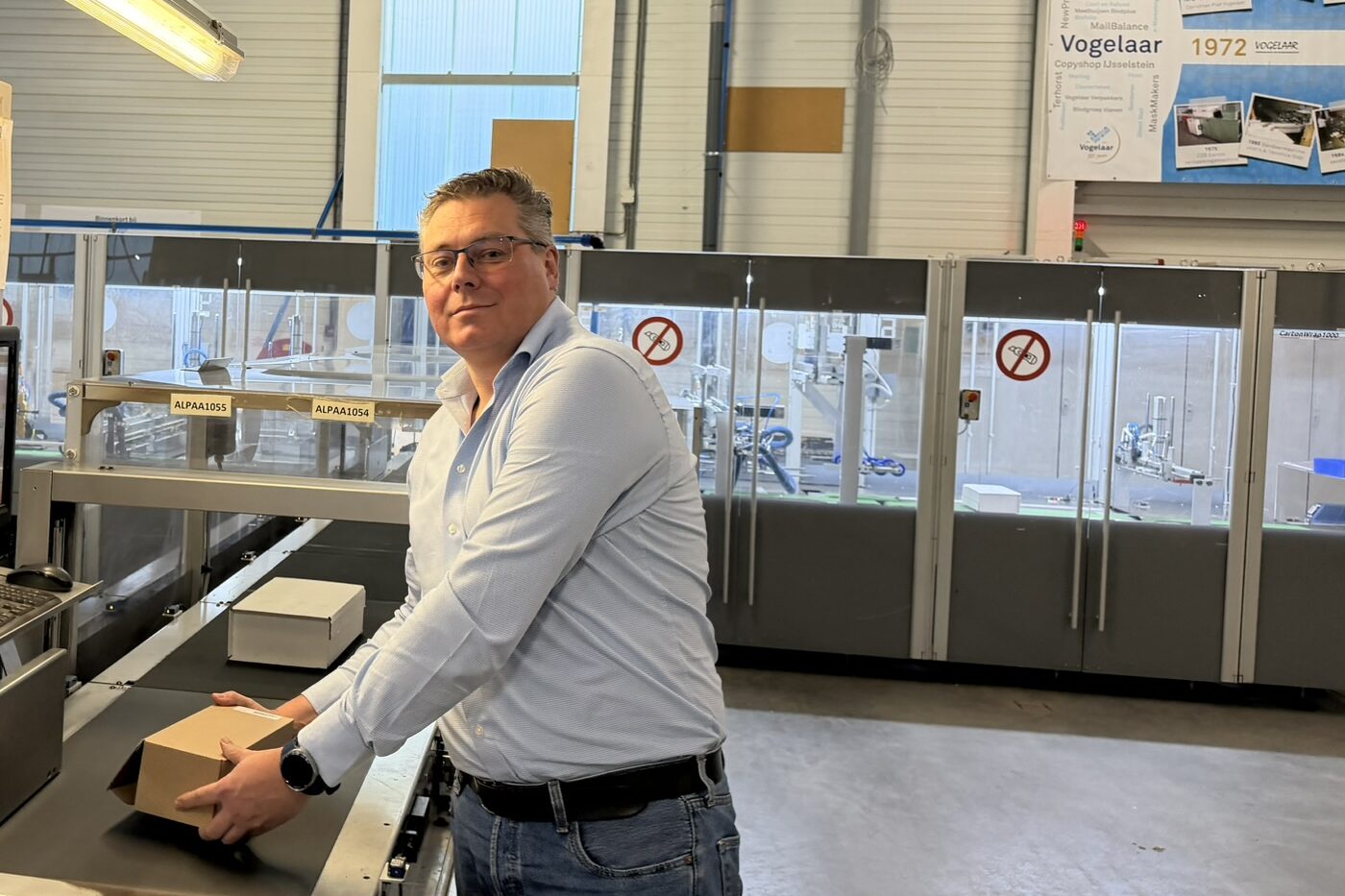
Last updated: 22 August 2026 · Jeroen Balke, operations director of Vogelaar
When outsourcing pays off
- You ship more than a handful of parcels a day on a structural basis. Below that line you are mostly setting up something you do not need yet.
- Your peaks do not fit your staffing. A campaign, a season or a promotion doubles your volume for six weeks. You do not hire people for that and you do not rent extra space for it.
- The warehouse costs you attention you want to spend on selling. This is the most frequently cited reason and rarely the first one anyone mentions.
- You want to be able to grow without rebuilding first. More orders means more picking here, not renting more square metres.
- There is more to it than shipping alone. Print, a personalised letter in the box, a campaign with a premium enclosed. If those things sit with different suppliers, you are the link holding it together.
When you are better off keeping it in house
Almost nobody writes this part down, and it is the honest half of the answer.
- At a small and stable volume. Building a connection, transferring stock and aligning processes is one-off work on both sides. At a few orders a day you usually do not earn that back, unless those orders are business orders and large.
- If your customers mostly collect. If you sell largely locally or at the door, outsourcing puts an extra transport step into a chain that does not need it.
- If your range is still moving in all directions. Anyone still working out what sells benefits from having the stock within reach.
- For products with special requirements. Temperature, licences, age verification, hazardous goods. That is possible, but it is a conversation up front and not an assumption.
- If you already have the space and the people anyway. If the building is there and you have staff to spare, outsourcing is a cost with no saving against it.
What to watch for if you do outsource
| On what | What you actually ask |
|---|---|
| Shipping | Which carriers, what cut-off time, how do returns work, and can someone also collect their order |
| Visibility | Do you see your stock live, do you get an alert at a low level, and what do you see of an order in transit |
| Costs | Which items are charged on and which are not. Push on what happens outside the standard process |
| Connection | How does it fit your web shop, who builds that, and how long does it take |
| Contract | How long are you tied in, and what happens to your stock if you leave |
The question that predicts most is the fourth. Do not only ask whether a company integrates but also how long it takes and who builds it. That is where you notice whether someone has done it before.
What moving over costs
Less than you think on the technical side, and more on the practical side. The connection itself is usually quick to lay: we connect by API to our WMS, and that works with Shopify, Magento, Lightspeed, MyShop, WooCommerce, JouwWeb and with virtually any other system that has an API. Orders then come in in real time, with track & trace and delivery confirmation.
What does take time is the ordinary work around it: your stock has to come across physically and administratively, and the arrangements about cut-off, returns and exceptions have to be set down properly once. You do that once.
What we do, and with what
We manage 12,000 different products, millions of units in total, and since 1 January 2026 we run entirely on the Picqer WMS. Our CMC CartonWrap makes a made-to-measure box for every order, up to 600 parcels an hour, integrated with that WMS.
What sets us apart is not the warehouse but the combination: print, personalising and shipping sit under one roof here. So an order can be printed, personalised, packed and shipped without a lorry in between.
And it does not have to be standard. Does a card have to go with it, handwritten or personalised in print? A gift wrap, an insert that differs per recipient, a box that looks different for a campaign? We set that up. Because we build our own software around the WMS, we can simply make a process that runs slightly differently. So outsourcing with us does not mean compromising on what your parcel looks like.
Arranged and assured: ISO 27001 and ISO 9001, CO₂-neutral, centrally located in the Netherlands.
What exactly we take care of is on Fulfilment. If you already know what you want to outsource, request a quote and we will cost it out.
More in Insights
This article belongs to Fulfilment. Back to the overview, or carry on with one of these.