Does your web shop need a withdrawal button?
Yes, since 19 June 2026, if you sell to consumers in the EU through an online environment. The button has to be immediately findable and work in two steps. It does not apply to products made to the customer's specification.
Last updated: 22 August 2026 · Jeroen Balke, operations director of Vogelaar
What exactly has changed
The right of withdrawal itself is not new. A consumer buying online has fourteen days to change their mind, and that has been in Article 6:230o of the Dutch Civil Code for years.
What has been added is the way they exercise that right. Since 19 June 2026 there has to be a button, and the model form alone is no longer enough. The thinking behind it is simple: a contract you conclude online in two clicks, you should also be able to dissolve online in two clicks.
That follows from Directive (EU) 2023/2673, implemented in the Netherlands as Article 6:230oa of the Civil Code.
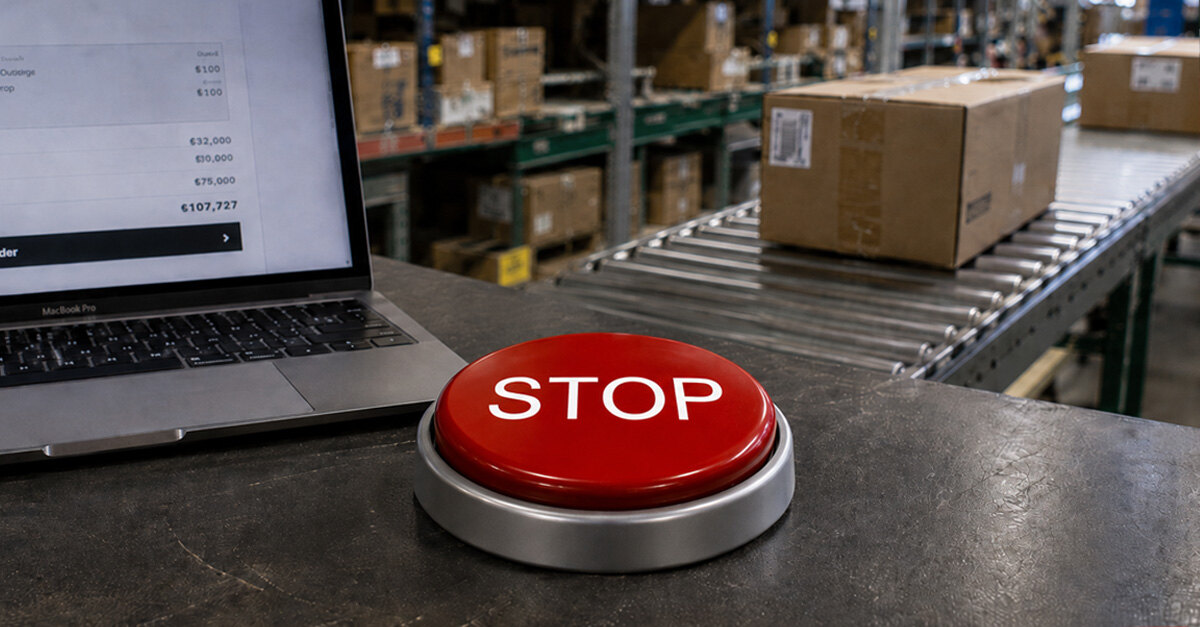
What the law asks of the button
| Requirement | What it means in practice |
|---|---|
| Immediately findable | Visible on desktop and mobile, without searching and without logging in. A guest buyer has to be able to reach it too |
| Only the necessary details | A name, something that identifies the order, and an address for the confirmation. No more |
| Two steps | Fill in, and then confirm on a separate page. That prevents an accidental withdrawal |
| Confirmation of receipt | Immediately after confirming, with the date, the time and what was declared |
| Available for the whole period | Not clicked away, not switched off, not dependent on office hours |
Source: Directive (EU) 2023/2673 and Article 6:230oa of the Dutch Civil Code.
The existing model form simply stays. The button is added to it as a low-threshold route.
Who does it not apply to?
If you sell business-to-business only, it falls outside your scope. The right of withdrawal is consumer law. If the same shop also serves consumers, the obligation applies as normal.
And there is an exception that often applies to our customers: for products made to the consumer's specifications there is no right of withdrawal in any case. That is in Article 6:230p of the Civil Code. Think of personal print, a personalised mailing or bespoke work. For catalogue items and standard products it does apply.
Why this is an operational story and not a legal one
The text of the law is straightforward. Practice is not, because when cancelling gets easier, more comes back. And that affects the whole chain behind that button.
The refund period starts running at the withdrawal. You may wait to refund until the goods are back or until there is proof of dispatch, but then the route from consumer to warehouse to system has to run quickly enough. Delay between web shop, order system and warehouse becomes money at that moment.
More comes in than before. More cancellations, including after dispatch. So more inbound flows, more checking of what comes back and more stock corrections. If you are already tight on returns capacity, you feel that first.
The button creates a new kind of message. A withdrawal is not the same as a returns notification. That message has to get from your web shop to your fulfilment, and whether that happens automatically or by hand is a matter of days.
What we notice of it
Honestly: not much yet. Since 19 June the subject has barely come up with our customers, and that says most of all about how quietly an obligation like this can take effect.
What we do see is a consequence of speed. At many of the web shops we serve, an order is already staged or already on its way before a consumer changes their mind. Note what that does and does not mean. The right of withdrawal does not disappear with it: the fourteen days start on receipt, not on dispatch. What disappears is the option of still stopping the order. A withdrawal then reaches us as a return and not as a halted order, and that is a different process with different costs.
Which is also the practical advice: expect most withdrawals to reach you as a returns flow, and set your capacity up for that.
What you can check now
1. Is the button there, and can it be found without logging in? Test it yourself as a guest buyer, on your phone. 2. Does a withdrawal actually reach whoever stops the order? A button that only sends an email to customer service moves the problem. 3. Do you know how long your chain takes from withdrawal to refund? Measure it once on a real order. 4. Do you know which of your products fall under the bespoke exception? Set that down, because you do not want that discussion case by case.
This is not legal advice. For the legal side we are happy to refer you to a lawyer or to a trade body such as Thuiswinkel.org. We look at the chain behind the button.
Is your returns flow still running as it should? What we do in fulfilment is on fulfilment, and whether outsourcing makes sense for you is at outsourcing fulfilment. If you would like us to take a look with you, request a quote or call your regular contact.
More in Insights
This article belongs to Fulfilment. Back to the overview, or carry on with one of these.