
What is changing in the postal market, and what that means for your mailing
Longer delivery times, higher rates and hand-in shifting two days earlier. What has been decided, what is coming, and why business mail works differently than you think.
In short
- Business mail is not regulated. There is no statutory delivery time and no price cap. PostNL sets the terms itself.
- That covers by far the most mail. Around 95% of the volume comes from companies and institutions, and around 85% falls outside the universal service obligation. The news is almost always about the other 15%.
- For business mail, next-day delivery already disappeared on 1 January 2025, eighteen months earlier than for ordinary mail.
- Since 12 July 2026 a two-working-day term also applies to mail under the universal service obligation. If letter volumes keep falling it becomes three, from 2028 or 2029.
- Faster delivery still exists, but as a separate and more expensive product routed through the parcel network.
- For Next week Flex, the hand-in moment shifts on 1 January 2028 from Friday to Wednesday, two full production days earlier. The product already exists; what changes is when you have to hand it in. It is the cheapest product, so this affects direct mail too, not only periodicals.
- The Postal Act has been under revision for six years. The bill has been before the House of Representatives since 30 March 2020 and still has not been passed.
First this: there are two kinds of mail, under two very different regimes
The news is nearly always about the universal service obligation — in the Netherlands the Universele Postdienst, or UPD. That is the basic provision laid down in law: everyone in the Netherlands must be able to send and receive mail. Rules come with it. The minister sets the delivery time, the ACM (the Dutch competition authority) decides how much PostNL may charge on average, and it is enforced. In May 2026 PostNL was fined almost seven million euros because in 2023 only 89.48% of universal-service mail arrived on time instead of the required 95%. In 2024 and 2025 those percentages were not much higher, so fines for those years are to be expected.
But almost everything a company sends falls outside it. A mailing, a membership magazine, an invoice run, a periodical: that is business mail, also called bulk mail. And that whole system does not apply to it.
For business mail there is no statutory delivery time and no price cap. No standard PostNL has to meet, no maximum on what it may cost. The terms are set out in the contracts and service frameworks PostNL draws up itself.
And now the proportions
This is where it gets interesting, because the attention and the volume are the wrong way round.
| Share of the volume | |
|---|---|
| Mail from consumers | ± 5% |
| Mail from companies and institutions | ± 95% |
And if you look at what is and is not protected by law:
| Share of the volume | |
|---|---|
| Falls under the universal service obligation | ± 15% |
| Falls outside it | ± 85% |
Those two tables do not say the same thing. The universal service obligation is broader than consumer mail alone: it also contains business mail, such as franking-machine mail, international bulk mail and individual business items posted in a public letterbox. Hence 15% and not 5%.
What it comes down to: the law does not govern around 85% of all mail delivered in the Netherlands. No delivery standard, no price cap, no supervision of the terms. Meanwhile the news, the parliamentary debates and the fines are almost entirely about just 15% of the total mail volume.
That difference is the heart of this whole story. If you send a mailing or a magazine, the universal-service decisions that make the papers are mainly an indication of the direction for you, not the rules you actually deal with.
Source: Netherlands Authority for Consumers and Markets, "De postmarkt in transitie" (in Dutch).
What has happened to business mail
The changes to business mail came earlier than those to the universal service, and went further.
2023: three changes at once. Monday delivery disappeared. Saturday delivery for periodicals was dropped unless you chose a more expensive rate. And a requirement to hand in a day earlier was introduced.
1 January 2025: next-day delivery disappeared. For business mail, two days became the standard. That was eighteen months before the same step was taken for ordinary mail.
2026: the universal service follows. From 12 July, two working days apply there too.
2027: a new service framework, and three days. PostNL wants to revise the terms for business mail again. Delivery moves to three days, and the hand-in moment shifts.
You can see the pattern: business mail goes first, regulated mail follows. That makes sense, too. Changing the universal service requires a ministerial decree, a consultation and sometimes an amendment to the law. Changing business mail requires an announcement.
And there is nowhere else to go. For letterbox mail there is currently no second nationwide network in the Netherlands. On the business mail market PostNL is therefore a monopolist whose terms are not regulated: one party sets the rules unilaterally, and unlike the universal service there is no delivery standard or price cap against which they are tested.
Delivery times under the universal service obligation
For completeness, because this is what makes the news and it shows the direction of travel:
| From | Term | Delivery reliability |
|---|---|---|
| Until July 2026 | Next working day (D+1) | 95% |
| 1 July 2026 | Two working days (D+2) | 90% |
| 2028 or 2029 | Three working days (D+3) | 95% |
PostNL implemented the move to D+2 in its rates and products on 12 July 2026.
Pay particular attention to that third column. Delivery reliability is the standard PostNL has to meet for the universal service: at 90%, one in ten items may arrive later than the stated term. For business mail no such standard exists. So for a time-critical mailing, do not plan with a delivery time but with a margin.
What it costs
New rates and a new structure have applied since 12 July 2026:
- Standard post costs €1.40 per stamp and arrives after two working days.
- Fast delivery runs through the parcel network and has become a separate product: €3.25 for bereavement mail and €3.95 for an express letter.
That is a substantive change. Speed used to be included in the price of the stamp; now it carries a hefty surcharge.
The cheapest product for business mail is Next week Flex, for delivery in the week after hand-in. It already exists and is listed in the rate booklets as usual. What changes on 1 January 2028 is not the product but the hand-in moment — see the next section.
Bulk mail has different rates from stamped mail in any case. Those are in the rate booklets PostNL publishes annually, and they have risen sharply since 2019.
The stamp price itself rose by 8.3% (July 2025) and 6.9% (January 2026). For 2026 the ACM set the tariff headroom for the universal service at €3.1882 against €2.9084 in 2025, a rise of 9.6%. That headroom is the maximum PostNL may charge on average — it is not a stamp price, but it does show the direction.
Next week Flex: hand-in shifts two days earlier
At a webinar on 21 July 2026, PostNL announced that D+2 is "only a first step". Next week Flex, the product for delivery in the week after hand-in, already exists. What changes on 1 January 2028 is the hand-in moment: it moves from Friday to Wednesday.
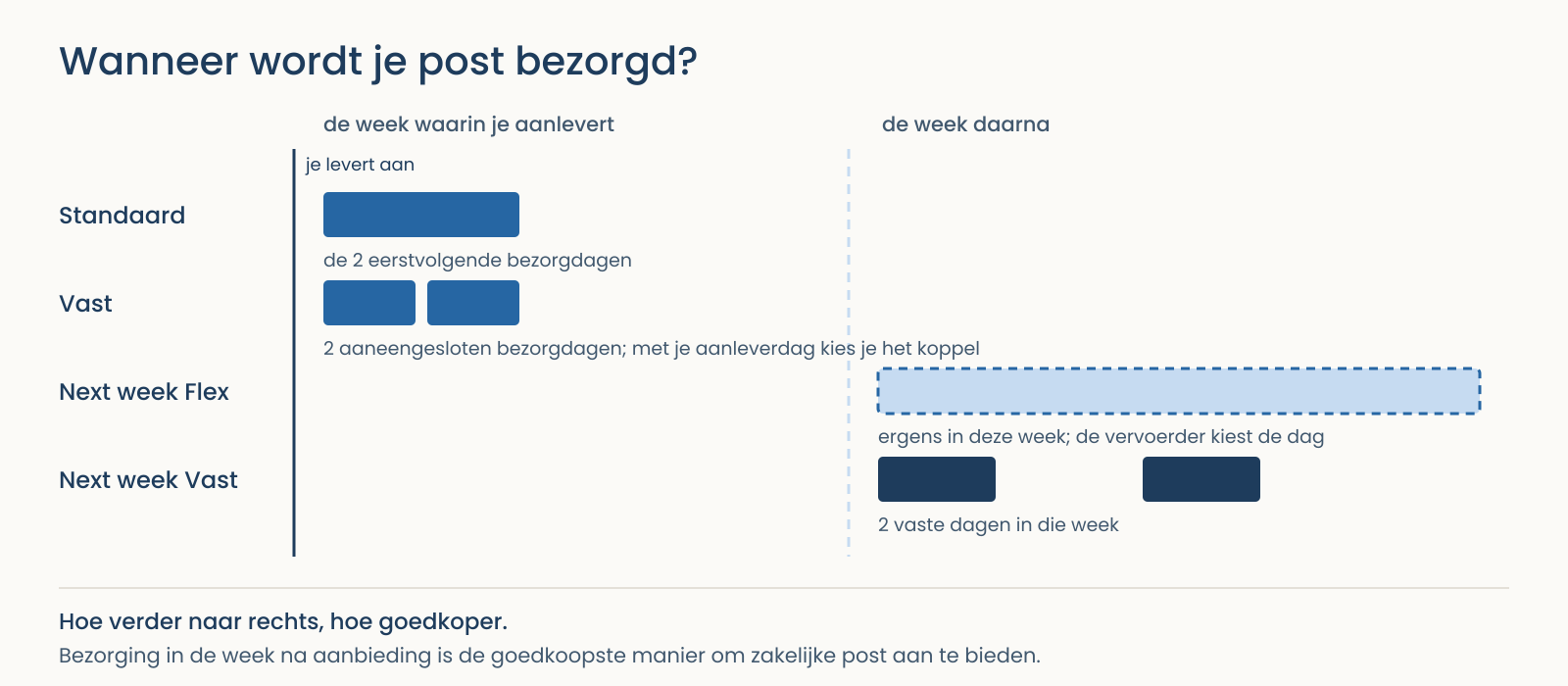
This affects everyone, not just publishers. Next week Flex is the cheapest way to hand in mail, and therefore the logical choice for the vast majority of business mail. Anyone who chooses it will have to hand in everything two days earlier from 2028. A periodical, but equally a direct mail campaign or a mailing to an address file.
And it shifts more than just your own deadline. Handing in two days earlier at PostNL means everything before it shifts two days too. The print work has to be ready two days earlier, so the printer has to start two days earlier, so the file and the proof have to be settled two days earlier. For anyone publishing a periodical that chain runs all the way into the editorial office: copy deadline, advertising deadline and approval round all move with it.
At Vogelaar that entire route sits under one roof: printing, personalising, enveloping and mailing. That saves the hand-offs between suppliers that normally cost exactly the days you are now losing. But it applies to us as well: the clock starts two days earlier.
And it does not only affect you. Because the peak shifts two days forward for all senders at once, finishing capacity on Monday and Tuesday becomes scarcer. Anyone with several titles or campaigns will get them all on the same days.
It is not the first step in that direction, either. In 2023 Monday delivery disappeared, Saturday delivery for periodicals was dropped unless you chose a more expensive rate, and a requirement to hand in a day earlier was already introduced.
What this means for your mailing
For a periodical, membership magazine or magazine. The topicality of your title is limited by the new deadline. News from Tuesday to Thursday will no longer make the Friday issue. Associations that hold their board meeting on Tuesday or Wednesday and want the outcome in the magazine run straight into this.
In practice you have two routes: choose Next week Flex and give up some topicality, or choose a more expensive product to keep the original delivery day. Which of the two is wiser depends on your title and how often you publish: for a trade journal that appears four times a year with background pieces the answer differs from a weekly that lives on the news. The more often you publish, the more often you lose those two days, and the more it weighs.
For a direct mail campaign. Here too, hand-in moves to Wednesday as soon as you choose Next week Flex. Plan backwards from the date the mailing has to be on the mat, and allow for delay given the delivery reliability. So count back, rather than forward from the moment you are ready. For a campaign tied to an event or a season, that margin is the difference between on time and too late. Charities that respond to the news lose the most flexibility here.
For invoices and transactional mail. Terms that run from the date of dispatch — payment terms, response periods and reminders — effectively get one to two days less room. Check whether your standard terms still fit.
For your storage and planning. Handing in earlier means print work sits with you or with your mailing partner for longer before it goes out. That takes space. So reserve print and finishing capacity earlier than you are used to, especially around the peaks in the year.
What you can already do now
Count back from the delivery date. Not "when are we ready", but "when does it have to be on the mat", and then count backwards. We are happy to do that arithmetic for you.
Check whether your service framework still fits. For time-critical mailings a faster and more expensive product can make sense; for most of the rest Next week Flex will be the sensible choice. It pays to look at this per title or per campaign rather than choosing the same thing for everything.
Rework your editorial planning now. If hand-in shifts, everything before it shifts too. That is easier to set up properly once than to improvise every issue.
Keep a margin for delay. Delivery reliability is a standard, not a guarantee. As the bags get fuller and the shortage of deliverers persists, running late is becoming the rule rather than the exception. Plan a few days of slack for it, certainly around a fixed date.
Look beyond the postage. As delivery gets slower, the rest of the chain matters more. Think of a format that comes more efficiently off the printed sheet, a self-mailer instead of an envelope, or an issue that goes out unwrapped with the address on the cover.
How it came to this
A brief chronology for anyone who wants the background.
2019: PostNL acquires its competitor Sandd. The ACM advised against it; the state secretary approved the acquisition anyway on grounds of the public interest. At the time the ACM predicted that business mail rates would rise by 30 to 40 per cent if the competition fell away.
30 March 2020: The bill to revise the Postal Act 2009 is introduced. Six years later it still has not been passed.
2023: For business mail, Monday delivery disappears and Saturday delivery for periodicals is dropped unless you pay a higher rate. A requirement to hand in a day earlier is introduced.
12 September 2023: The House of Representatives declares the bill controversial and suspends consideration until after a new government is formed.
1 January 2025: For business mail, next-day delivery disappears; two days becomes the standard.
August and September 2025: Consideration resumes. A letter of amendment is issued, and on 3 September the House holds a round-table hearing with experts.
December 2025: The Trade and Industry Appeals Tribunal rules that the Sandd acquisition should not have been approved at the time. The ACM has been asked to investigate what consequences should follow. That outcome is not yet in.
December 2025: The government rejects a request to withdraw PostNL's designation as universal service provider. The reasoning: a second nationwide network is not viable in a shrinking market. Instead the terms of the universal service are being adjusted, including the delivery time.
February 2026: The House of Representatives debates the accompanying Postal Decree and tables four motions, among other things on delivery reliability under D+3 and on access to the nationwide network for regional postal companies. The bill itself still has not been put to a vote.
April 2026: The decree becomes final; PostNL keeps the designation.
May 2026: The ACM fines PostNL for failing to meet the delivery standard in 2023. That same month the minister informs the House that mandatory network access for regional postal carriers will be included in the revised Postal Act, supervised by the ACM and with a five-year transition period.
July 2026: The new terms, rates and products take effect. At the webinar of 21 July, PostNL announces that the hand-in moment for Next week Flex will move from Friday to Wednesday on 1 January 2028.
1 January 2028: The hand-in moment for Next week Flex shifts two days, from Friday to Wednesday.
2028 or 2029: The delivery time for the universal service may go from two to three working days, if mail volumes keep falling.
The new Postal Act: six years under way
The bill to amend the Postal Act 2009, parliamentary paper 35423, was introduced on 30 March 2020. It still has not got through.
That is not a detail. It explains why PostNL keeps adjusting the terms for business mail itself in the meantime: the law that ought to say something about it does not exist.
The route so far:
| When | What happened |
|---|---|
| 30 March 2020 | Introduced in the House of Representatives |
| 18 May 2020 | Committee report |
| 28 September 2020 | Government response to the committee report |
| 28 November 2022 | Progress letter from the government |
| 12 September 2023 | Declared controversial; the House decides not to consider it until there is a new government |
| 25 August 2025 | Letter of amendment: the bill is revised |
| 3 September 2025 | Round-table hearing with experts in the House of Representatives |
| 18 December 2025 | Further committee report |
| 11 February 2026 | Two-minute debate on the accompanying Postal Decree, with four motions |
| 12 February 2026 | Government response to the further committee report |
The bill is still listed as "under consideration by the House of Representatives". So it has not been passed, not rejected and not withdrawn.
There are two visible reasons why it is taking so long. In September 2023 the House declared it controversial — a decision to leave a subject alone until after the elections, because a caretaker government should not be settling such matters. And there is substantive criticism.
What the experts said about it
On 3 September 2025 the House of Representatives held a round-table hearing with the ACM, postal companies, trade unions and an independent academic. That last one, Maarten Pieter Schinkel, professor of competition economics and regulation at the University of Amsterdam, called the bill "exceptionally poor".
His objections concern two things that matter particularly to business senders:
- The access tariff disappears. Regional postal companies collect local mail, but that always includes letters that have to be delivered outside the region. Under the current Postal Act, PostNL has to deliver those nationally on their behalf at a regulated, low price — precisely in order to make competition possible. Schinkel on scrapping it: "The ministry wants to abolish the regulated low outbound tariffs for regional deliverers. That further strengthens PostNL's market power."
- The maximum price for the stamp is being released. Instead, PostNL may raise all its rates as long as the profit on the letters business stays below a certain ceiling. Schinkel calls that so-called rate of return regulation too lenient, and points to the risk of costs being allocated strategically.
That is not a theoretical objection. When the Sandd acquisition was approved, a 9% return cap was imposed for the same reason, specifically to counter unchecked rate increases. In practice such a ceiling is barely testable: whether a cost belongs to the letters business or somewhere else in the group is almost impossible to establish from the outside. Exactly what Schinkel warns about.
Together with other economists he argues for a different model: nationalise the postal infrastructure and auction the operating licences periodically, with a lean, politically determined universal service duty.
This is the view of an independent expert at a public hearing, not the position of Vogelaar. We include it because it explains why this law has been sitting still for six years.
The part that matters most to senders is mandatory network access for regional postal carriers. If that comes, then in time — with a five-year transition period — there will for the first time in years be an alternative for part of the business mail market. At present, for letterbox mail, there is none.
Read it yourself? The full file is public (all sources in Dutch):
- The file at the House of Representatives, all documents, by date
- The bill as introduced (pdf, 30 March 2020)
- The letter of amendment (pdf, 25 August 2025), which contains the most up-to-date text
- Overview and state of play at the Senate
- Watch the round-table hearing of 3 September 2025; Schinkel's contribution starts at 1:42
- The position papers from the ACM, PostNL, Spotta, Business Post, FNV and CNV
- Schinkel's explanation on the University of Amsterdam website
In the press
These changes regularly make the news too. A few pieces that cover the subject well (all in Dutch):
- PostNL verandert ook regels bezorging zakelijke post: "Dood voor het weekblad", De Telegraaf. On what the shifting hand-in moment means for regional weeklies.
- PostNL zet koers richting verdere verschraling, the KVGO, the Dutch printing and media industry association.
- PostNL 2026: wat verandert er voor zakelijke mailingen?, PRINTmatters.
- ACM: meer tijd voor postbode doet betrouwbaarheid bezorging geen goed: NOS.
Our owner Mark Bonenkamp is regularly quoted in that coverage, as chair of the Postal Committee of the KVGO.
There is also the ruling by the Trade and Industry Appeals Tribunal on the Sandd acquisition. The ACM is investigating what consequences should follow; when there will be clarity is not known. What it means for the market cannot be said at this point.
We follow it closely, not least because our owner Mark Bonenkamp chairs the Postal Committee of the KVGO and Stichting Postfilter, the Dutch mail preference foundation. As soon as something changes that affects our customers, we publish it here.
Laatst bijgewerkt: 5 August 2026
More in Insights
This article belongs to Direct mail. Back to the overview, or carry on with one of these.