What do all those terms mean?
Sealen, couverteren, rondelleren, partijenpost, Next week Flex. We use those words all day, and outside our trade almost nobody knows them. They are explained below, in plain language. The Dutch term stays as it is, because that is the word you will meet on our quote and in our email.
Last updated: 22 August 2026 · Mark Bonenkamp, managing director of Vogelaar, chair of Stichting Postfilter and of the Postal Committee of the KVGO, member of the Postal Committee of the DDMA
Packing and addressing
What is sealen?
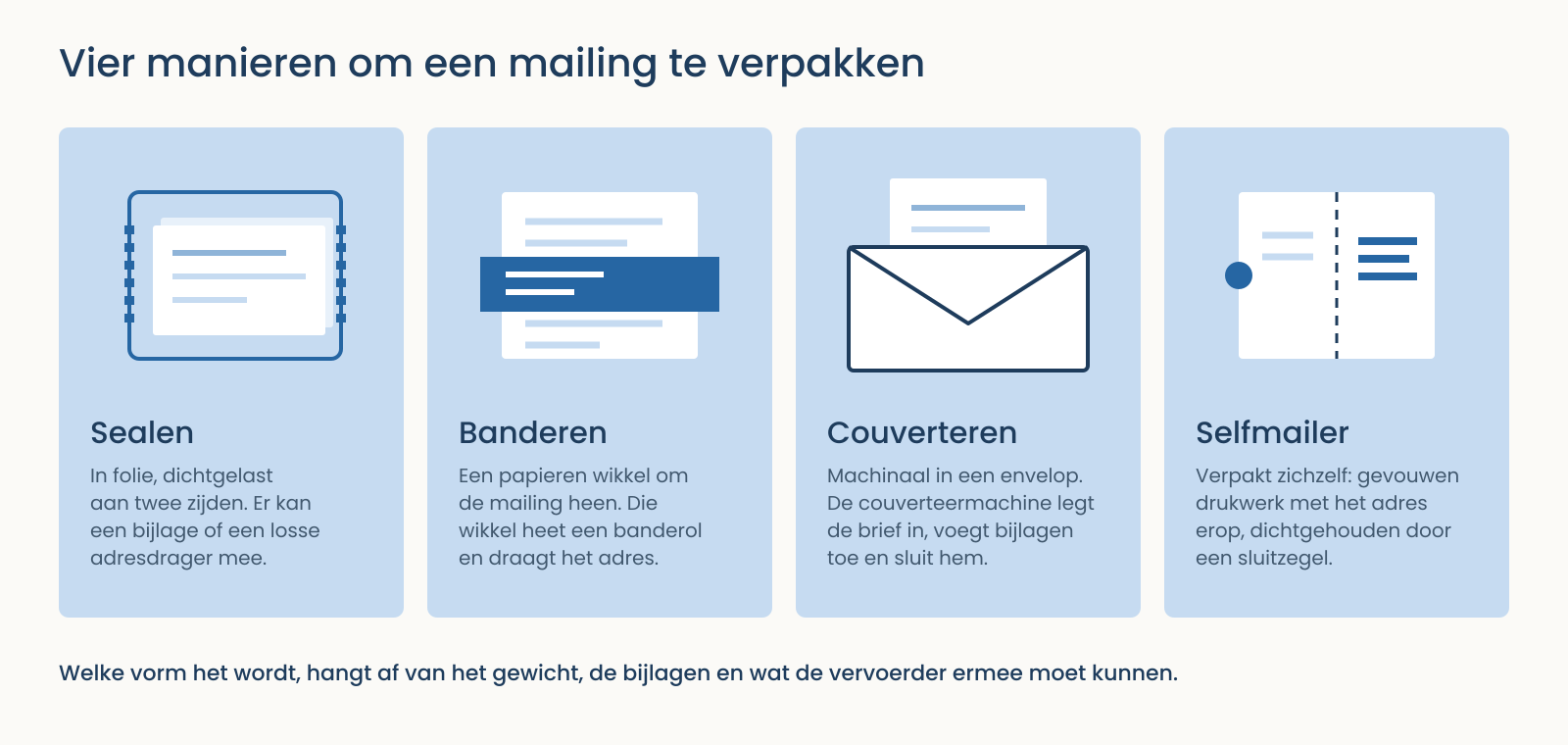
Shrink or poly wrapping: packing a mailing in film. That protects it against damage and makes it possible to send inserts or a loose address carrier with it. As standard we seal in cane sugar film; what that is and is not is on mailing sustainably.
What is banderen?
Banding: packing a mailing in a paper wrap. That wrap is called a banderol and usually sits around a magazine, folder or periodical. It normally carries the address and can carry a message as well. With us a banderol is at least ten and a half centimetres wide; above that it can become as wide as the mailing itself.
What is a cheshire?
A paper address carrier added to a mailing, usually loose inside the seal film or on the banderol. Handy when the address cannot or may not go directly on the print.
What is couverteren?
Enclosing: bringing a mailing together in an envelope, by machine. An enclosing machine puts the letter in, adds the inserts and slides the whole thing into the envelope.
What is a selfmailer?
A mailing that packs itself: a folded printed piece that can go into the mail without an envelope, film or banderol. The address is printed straight onto the piece. It saves material and usually postage too.
Printing, personalising and finishing
What is the difference between drukken and printen?
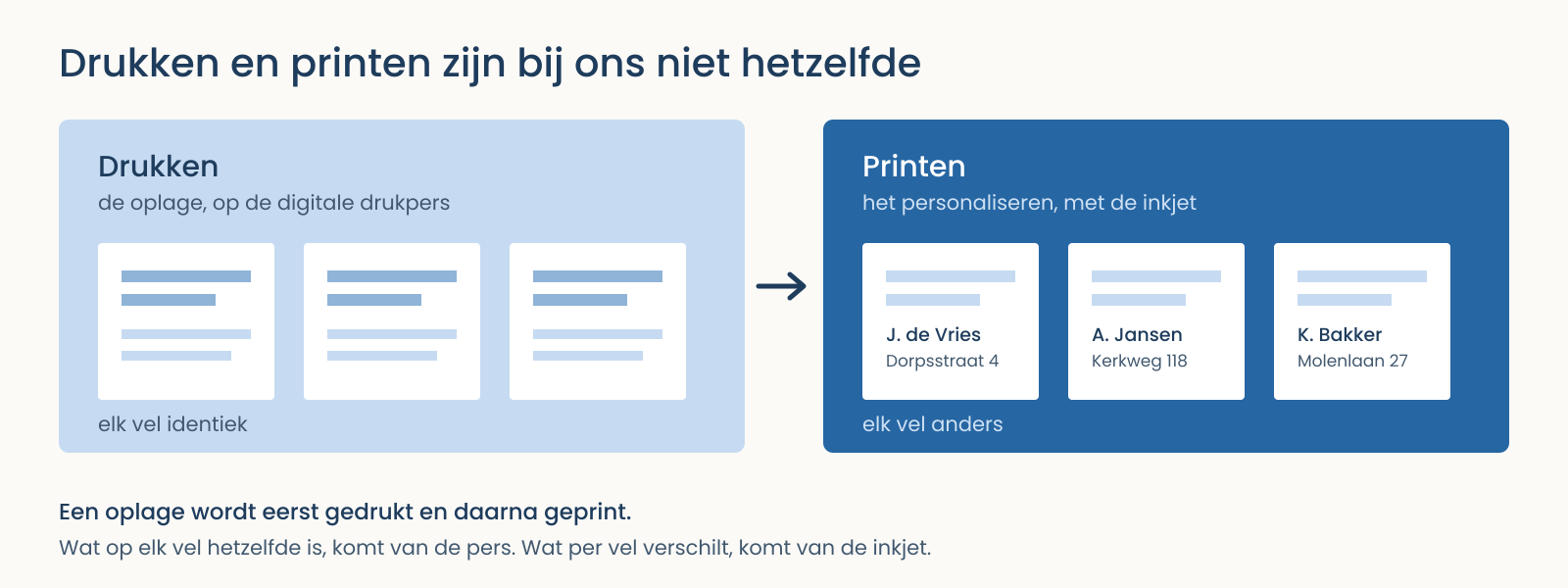
English has one word for both, Dutch has two, and with us they are not synonyms. Drukken is making the printed piece itself, on our digital presses. Printen is what we call personalising: the name, the address and the variable data that differ per copy. So a run is first gedrukt and then geprint.
What is personaliseren?
Personalising: putting everything on the print that differs per copy. A name, an address, a customer number, a personal offer or an individual QR code. That happens at the printing stage and not on the press.
What is inkjetten?
Inkjetting: a technique in which small drops of ink are sprayed onto the paper. We use it mainly for addressing and personalising, straight onto the print or onto the address carrier.
What is the oplage?
The print run: the number of copies you have made. It is the first question on every quote, because almost every cost item depends on it and the price per copy falls as the run rises; see what does a mailing cost. Note that the terms of delivery allow a small deviation in the quantity delivered: that is in article 12.
What is afloop?
Bleed: the strip of colour or image you continue beyond the final size, so that no white edge is left after trimming. If colour runs to the edge of your design, it needs bleed. How to supply a file is on sending us files.
What is a drukproef?
A proof: a sample for approval, before the whole run is made. What applies once you have approved a proof is in article 11 of the terms of delivery: after that, changes are no longer free.
What is brocheren?
Binding: bringing several pages together into one brochure or booklet.
What is rillen?
Creasing: making a fold line in thicker paper by machine, so that it can be folded without breaking. From 160 gsm upwards, creasing is required. If you skip it, the fold tears open and you see a white line. How much that shows depends on the paper and on the colour: on a sheet with heavy solid colour over the fold you see the crack at once, on unprinted paper hardly at all.
What is lamineren?
Laminating: applying a thin film layer to the print, gloss or matt. That protects against dirt and wear and gives the colours more depth. Used mostly on covers and on print that is handled often.
What is handmatige verwerking?
Hand work: the part of a mailing no machine can do. Inserting an unusual item, folding something that falls outside the machine format, or assembling a pack that is different every time. It appears as a separate line on your quote, because it is the most expensive operation we have and usually the first one you can design away.
What is vergaren?
Collating: laying loose sheets or sections together in the right order, before they are stapled or bound. In a booklet of several sheets, this is the step that determines the page order.
What is nieten or hechten?
Stapling or stitching: bringing sheets together with staples. In a booklet the staples sit in the fold, so in the spine. For thicker publications, binding or gluing is the better choice.
What is perforeren?
Perforating: applying a row of small holes so that a strip can be torn off neatly along it. Think of a reply slip below a letter or a voucher in a folder.
What is stansen?
Die-cutting: cutting out a shape that is not a rectangle, using a die. Think of a rounded corner, a slot a card fits into, or a card in an unusual shape.
What is rondelleren?
Wafer sealing: applying a closing seal, usually a small round sticker that holds a folded mailing shut. With us that operation also appears on the order as sluitzegelen.
What does grammage mean?
The weight of one square metre of that paper, written in grams or gsm. So 80 gsm paper weighs 80 grams per square metre. How to work with that is on paper sizes and weight.
Mail: rates and delivery
What is partijenpost?
Bulk mail: mail handed to the carrier in large quantities at once, sorted and pre-processed to its requirements. Lower rates apply to it than to single items. See saving on postage.
What do Klein, Groot, Speciaal and Gemengd mean?
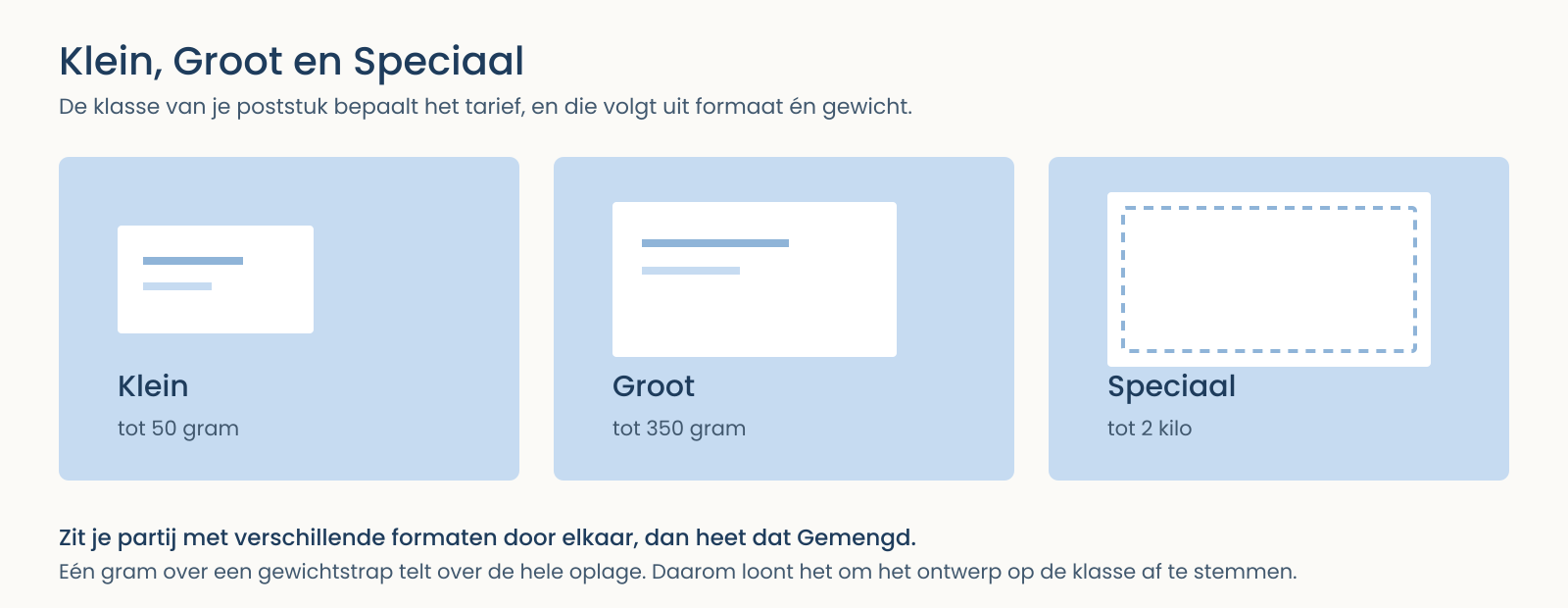
The product classes of bulk mail, sorted by size and weight. Small, Large, Special and Mixed, and the Dutch names are the ones on the rate card. Klein runs up to 50 grams, Groot up to 350 grams and Speciaal up to 2 kilos. Gemengd and Gemengd extra are for consignments in which different sizes are mixed together. Which class you land in sets your rate, and that is why it pays to design with it in mind.
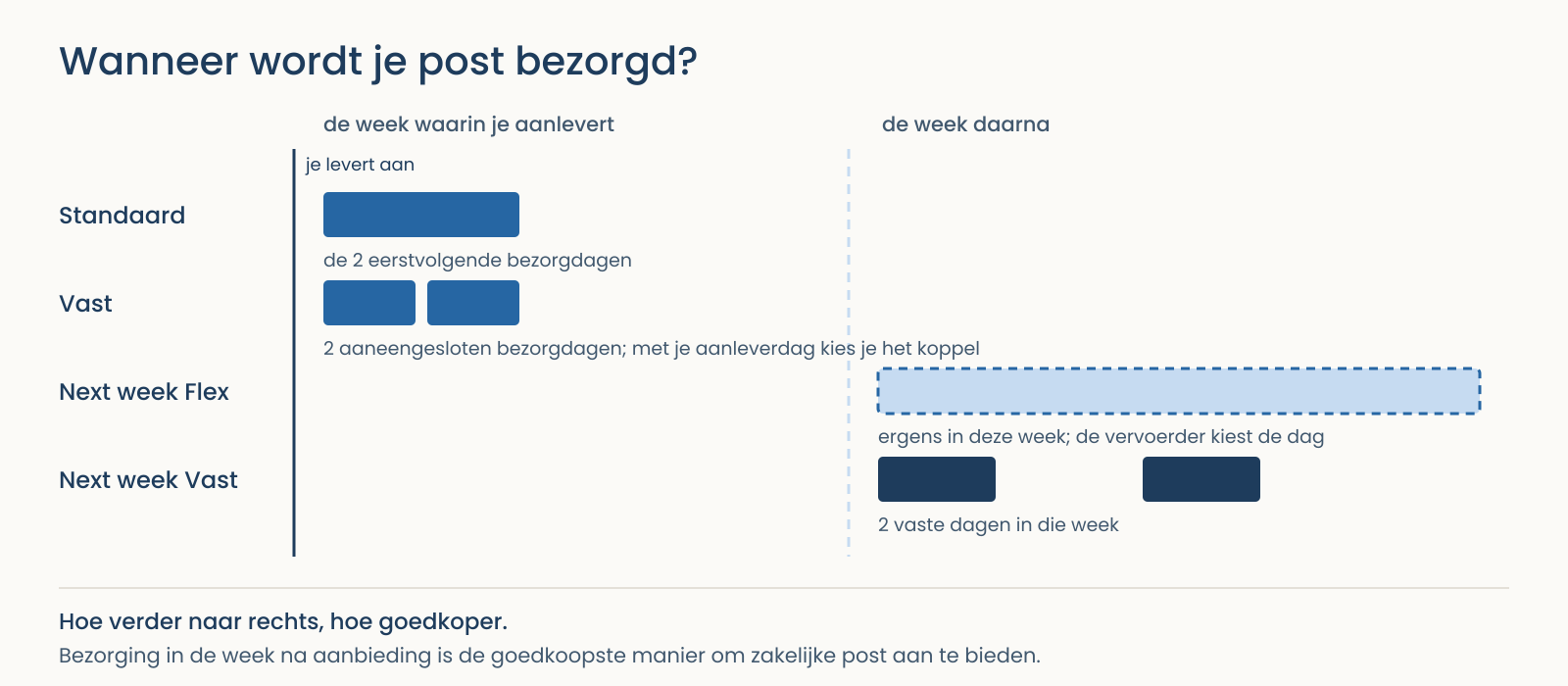
What is the difference between Standaard, Vast and Flex?
The three delivery options from PostNL's rate card.
| Option | What it means |
|---|---|
| Standaard | Delivery on the next two delivery days |
| Vast | Two pairs of two consecutive delivery days; your handing-in day decides which pair |
| Flex | Delivery in the week after handing in, on flexible days. Only for the sizes Groot and Speciaal, and the carrier decides the delivery day |
Source: the PostNL rate card of 12 July 2026.
Flex is the cheapest of the three. So you trade speed for price, and for most print that is a fine trade.
What are Next week Flex and Next week Vast?
That is what the delivery options in the week after handing in are called in practice. With Next week Flex delivery can fall on any day of that week, and the carrier decides which. With Next week Vast it falls on two fixed days, a week later. On the rate card they are called delivery in the week after handing in. What changes about the handing-in moment from 1 January 2028 is on what is changing in the postal market.
What do D+1, D+2 and D+3 mean?
The number of delivery days after the day of handing in. D+1 is the next working day, D+2 two working days later. For business mail PostNL went from D+1 to D+2 on 12 July 2026, and for 2027 there is a proposal for three days. See what is changing in the postal market.
What is a gewichtstrap?
A weight band: a rate step set by the carrier. All items within the same weight limits cost the same; go one gram over and you fall into the next band and pay that across the whole run.
What is a piektoeslag?
A peak surcharge: a surcharge the carrier applies in the busiest weeks of the year, November and December. If you are planning a mailing in that period, count on postage being higher than for the rest of the year. If the mailing can shift by a few weeks, that saves money.
What discounts are there on bulk mail?
Four, and they stack: you get them alongside each other if you meet the conditions.
| Discount | What it applies to |
|---|---|
| Volume discount | From 25,000 letterbox items per year, at least 3% |
| Coding discount | Depends on the size |
| Sorting discount | For Groot and Speciaal consignments from 5,000 items |
| Splitting discount | For domestic Gemengd and Gemengd extra consignments from 2,500 items: 1.0 eurocent per item |
Source: PostNL, rate card "Tarieven en diensten", in force from 12 July 2026.
If you cannot reach a threshold on your own, it can still work: we hand in according to the carrier's requirements, so a run that is too small in itself does fall into the right sorting with us. See saving on postage.
What is a buspakje?
A letterbox parcel: a small parcel that fits through the letterbox and so does not have to be handed over at the door. Cheaper than a parcel, and for webshops with small articles the difference between viable and not.
What does machinaal verwerkbaar mean?
Machine-processable: that your item can go through the carrier's sorting machines without anyone having to handle it. There are requirements attached: size, weight, stiffness, and what the address looks like and where it sits. If a consignment does not meet those, the carrier may apply a longer delivery time and charge extra handling costs. That is why we look at the layout before printing and not after.
What is the frankeerzone?
The franking zone: the box at the top right of the address side where the franking or the Port Betaald logo sits. At PostNL that is at most 74 by 40 millimetres, and the proportions of the logo may not be altered.
What is the indexzone?
The index zone: a strip that must be left completely empty, so that the sorting machine can put its own coding on it. On a landscape item that is an area of 140 by 20 millimetres below and to the right of the address, preferably white. If that zone is not kept clear, it can delay the consignment and cost money.
What is a codeerregel?
The coding line: the line with the sorting code printed below the address, with a unique code per address and delivery point. It belongs with the address block and is always combined with a letter code or a 2D matrix code. We put that line on; you do not have to produce it yourself.
Source for these four: PostNL, design conditions, valid from 18 August 2025.
Address files, registers and the industry
What is ontdubbelen?
De-duplicating: removing duplicate or unwanted addresses from a file, before anything is printed or sent. That can be the same person appearing twice, or addresses checked against a register.
What is Postfilter?
The Dutch register in which people can record that they do not want to receive addressed advertising mail. Anyone sending such mail has to consult that register beforehand. See Postfilter and the JA sticker.
What is the Overledenenregister?
The Dutch deceased register, with which you take deceased addressees out of your file so that no more mail arrives in their name. We consult it on the client's instruction, because it is their file and their judgement. See address files and privacy.
What is the JA sticker?
A sticker on the letterbox with which someone records that they do want unaddressed advertising print. More and more Dutch municipalities work this way. Mail by name falls outside it, but mail to the residents of can fall under it in those municipalities. See Postfilter and the JA sticker.
What is the DDMA?
The Data Driven Marketing Association, the trade body for data, privacy and marketing in the Netherlands. Among other things it draws up the code of conduct for direct marketing. Vogelaar sits on its Postal Committee.
What is the KVGO?
The Koninklijk Verbond van Grafische Ondernemingen, the Dutch trade association for the graphic media industry. The general terms and conditions our trade works with come from there; we apply them too. See terms of delivery. Vogelaar chairs its Postal Committee.
What is the ACM?
The Autoriteit Consument & Markt, the Dutch regulator for competition and for the postal market. Among other things the ACM assesses whether companies may merge, and supervises the rates of the universal postal service.
What was Sandd?
The second national postal deliverer in the Netherlands, taken over by PostNL in 2019. Since that takeover there has been only one national network for letter mail, and that explains a large part of how the postal market looks today. See what is changing in the postal market.
What is the CBb?
The College van Beroep voor het bedrijfsleven, the highest Dutch administrative court for economic matters: competition, regulation and decisions by the ACM. On 2 December 2025 the CBb ruled that the takeover of Sandd by PostNL should not have been approved at the time. The ACM has been asked to investigate what consequences should follow; that outcome is not yet in.
Rules, certificates and security
What is the PPWR?
The European packaging regulation, in full Regulation (EU) 2025/40, which has applied since 12 August 2026. The best-known requirement comes later: a shipping or e-commerce package may contain at most 50% empty space, and filling material such as paper shreds or air cushions counts as empty space. That requirement takes effect on 1 January 2030, or later if the European implementing act is still not in place by then. See sustainability; our information document PPWR en uw drukwerk is available from your contact.
What is ISO 27001?
The international standard for information security. A certified company has demonstrably arranged how it handles data, from access rights to suppliers, and is tested on that again every year by an external party. We have been certified since 2018. See security and certification.
What is ISO 9001?
The international standard for quality management. That is not about data but about your processes: do they do what they promise, and what happens when something goes wrong. We have been certified since 2021.
Who is the controller and who is the processor?
Two roles from privacy law, and the distinction decides who is liable for what. The controller (verwerkingsverantwoordelijke) decides why and how personal data are used; that is the client, because they are their customers or members. The processor (verwerker) does the work on instruction and may do nothing with those data on its own initiative; that is us. See address files and privacy.
What is a verwerkersovereenkomst?
A data processing agreement: the contract between those two roles. It states what we may do with an address file, how long we keep it, how it is secured and what happens if something goes wrong. We have one, and you can have it on request.
What is a bewaartermijn?
A retention period: the agreed time a file stays with us after the job, after which it is deleted. What applies to address files is in the data processing agreement and on address files and privacy.
How do you supply an address file securely?
Not as an attachment to an ordinary email: that is not secure and it jams after a few megabytes. Use the secure route on sending us files. No account needed, and your contact is notified straight away.
What is the herroepingsrecht?
The right of withdrawal: a consumer's right to cancel an online purchase within fourteen days without giving a reason. Since 19 June 2026 there has to be a button for it in the webshop. See the withdrawal button.
Fulfilment
What is fulfilment?
The whole route after the order: holding stock, picking orders, packing, shipping and handling returns. See outsourcing fulfilment.
What is pick-and-pack?
Collecting the articles of an order from the warehouse and packing them ready for shipping. It is the heart of fulfilment and usually the largest cost item too.
What is a made-to-measure box?
A shipping box made to fit the product for each order, instead of chosen from a handful of standard sizes. That saves cardboard and filling material, the product cannot shift and so arrives in better shape, and it saves volume in the lorry. See mailing sustainably.
What is an SKU?
Stock Keeping Unit: the unique code for one article in one version. A jumper in three sizes and two colours is therefore six SKUs. The more SKUs, the more locations in the warehouse.
What is a pakbon?
A packing slip: the list of what is in a parcel, which travels with the order. Usually also the place for a returns instruction or a leaflet.
What is a backorder?
An order that cannot be shipped complete because an article has run out. The remainder stays open and goes out as soon as stock is replenished.
What is derving?
Shrinkage: stock you can no longer sell, for instance a product that comes back damaged. With returns that is the item that turns out most expensive; see reducing returns.
Promotions
What is cashback, or cash and refund?
A promotion in which someone gets part of the amount back after buying, or an extra product. How that works and who is responsible for what is on what is cashback.
What is responsverwerking?
Response handling: dealing with everything that comes in on a promotion. Checking entries, answering questions, paying out or shipping, and reporting on it. Online, and by post if the brand wants that.
What does *inzake* on an account mean?
In a cashback promotion the money can run through a separate account held in the name of the promotion, in the form Vogelaar inzake the brand. The promotion budget sits there separately and does not run through our own funds. The alternative is that the brand pays out itself and we only supply the payment file. See what is cashback.
What is kansspelbelasting?
Dutch betting and lottery tax: the tax paid on prizes from a prize draw. The client pays that themselves or through their accountant; we do not take that over. We are happy to think it through before the promotion goes out.
Missing a term? Let us know and we will add it. And if you simply want to know what your mailing needs: request a quote, and we will explain it in plain language.